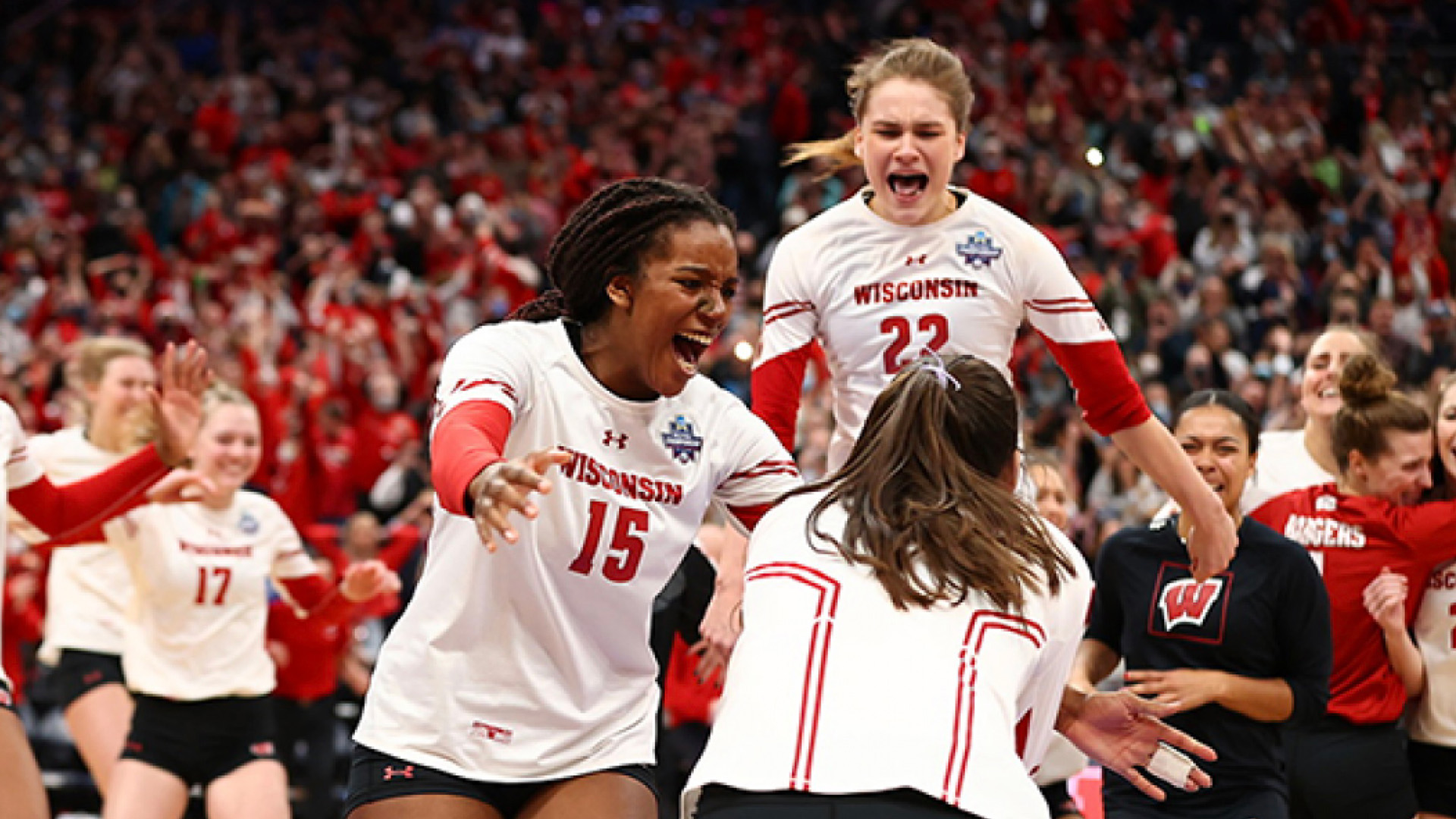
Texas A&M superstar Logan Lednicki didn’t wait for the roar to peak when the ball hit the floor during last season’s NCAA women’s volleyball championship game at T-Mobile Center. She immediately grabbed teammate Ava Underwood, hauled her clear off the court, and somewhere in the cacophony of maroon and white that spread across the Kansas City floor, the Aggies’ 128-year volleyball history ended without a national championship.
Texas A&M’s first crown
Kentucky did not find an answer. Three sets, three clinical statements — 26-24, 25-15, 25-18 — and the Aggies, a No. 3 seed who defeated just three No. 1 seeds in their tournament run, are national champions for the first time in history. Reaching the quarter-finals for the first time in a quarter of a century is an achievement in itself. Then came the semi-finals for the first time, the final for the first time and finally the championship for the first time.
Jamie Morrison stood courtside — “still speechless,” he would tell reporters moments later — after becoming only the third coach in NCAA history to win a national volleyball title in his first three years as a head coach. Now, though, the Texas A&M head coach faces an arguably more difficult task: defending the crown. And online betting sites will be acutely aware of the second mountain that awaits.
Last season, online crypto betting sites made the Aggies a +450 longshot when it came to the Final Four, but they will upset the odds to claim the crown. Next season, they will likely be unreal again. But as these four teams have proven over the past two decades, defending the title is not impossible.
Texas: The Sweep Dynasty
Logan Eggleston spent four years grinding for a Texas program that was supposed to win a national championship and arrived at the threshold without finishing the job. In December 2022, he decided to kick in the door himself.
Killed nineteen. AVCA National Player of the Year. Most Outstanding Player of the Tournament The Longhorns beat Louisville 25-22, 25-14, 26-24, and Eggleston — with setter Seje Cahayana-Torres feeding her like they shared a personal language and libero Joe Fleck keeping everything alive behind them — was simply challenging. Gerrit Elliott’s program, dormant since 2012, is finally back on top.
A year later, they were even better. Texas returned as the No. 5 seed to face top-seeded Nebraska in Tampa, and what transpired in front of thousands of fans — the largest crowd ever to attend an indoor volleyball match — was one of the wildest performances in NCAA Championship history.
Performed by Aszia O’Neill. and served. And serve again. Four straight aces in the second set broke Nebraska’s collective belief before the Huskers could catch their breath. Twelve service aces throughout the match, a championship record Elliott realized something about the program: The depth of the roster was down to such an extent that even with Eggleston gone and Ella Swindle a freshman setter stepping into the most pressing position on the court, Texas never trailed. Final score: 25-22, 25-14, 25-11. First program in NCAA history to win back-to-back titles with sweeps.
Stanford: Plummer Age
Was the Stanford dynasty of the Katherine Plummer era the most complete of the modern era? Here is the proof.
The 2018 final against Nebraska in Minneapolis was a five-set upset — 28-26, 22-25, 25-16, 15-25, 15-12 — with Stanford’s Megan McClure backrow kill claiming a program-record eighth title that sent the Cardinals to the bench. Kevin Hambley’s team survived every momentum swing, every Nebraska run, every moment when it looked like the game might be stolen. Setter Jenna Gray orchestrated with the composure of someone twice her age, the perfect conductor for an offense built to endure.
Twelve months later, Plummer closed out her college career with 22 kills in a 25-16, 25-17, 25-20 sweep against Wisconsin that announced something about how dynasties turn. 2018 was replaced by Chaos Command. Thriller gave way to dominance. Plummer — the two-time AVCA Player of the Year, arguably the most complete outside hitter in college volleyball history — was everywhere in that final, a performance that made a sold-out field feel like it was watching history in real time. A ninth title for Stanford. Third in four years.
Penn State: A dynasty within a dynasty
No. 2 seed Penn State walked into Seattle in 2013 with a program that shouldn’t have had a dynasty — the stars of the previous cycle were gone; The original was new – but Micha Hancock made it irrelevant. Forty-eight assists in the championship final against Wisconsin. Read as the number is worth reading: 48 assists across four sets. Arielle Scott led the way with 21 kills, Megan Courtney had 20 and Dominique Gonzalez added 20 more. Russ Rose’s program won 34 of 36 games that season. Claiming sixth title in school history.
The 2014 run as a No. 5 seed was even more daring. Penn State beat top-seeded Stanford in the national semifinals — a program that beat the machine that beat everyone else — and swept BYU 25-21, 26-24, 25-14 in Oklahoma City for a record seventh national championship. Hancock won the AVCA National Player of the Year. Back-to-back. Rose’s genius wasn’t a single player — it was a culture so deeply encoded in the program’s DNA that it produced identical results with completely different personnel.
The gold standard
Win 109 consecutive matches. The same ones the Nittany Lions collected between 2007 and 2010. No dynasty in NCAA women’s volleyball history has come anywhere close to Penn State’s famous four-peat, again under Rose.
They began their run in Sacramento in 2007 with a five-set thriller against Stanford and then became something the sport had never seen and hasn’t seen since — 38-0 in 2008, then 38-0 again in 2009. Two perfect seasons in a row. Won one hundred and nine matches in a row. One hundred and eleven straight wins. A cumulative four-year record of 142-7. Defining a championship culture operating without ego or compromise.
Outside hitter Megan Hodge was the dynasty’s dominant force, but it wasn’t a one-player program. Setter Alisha Glass, a two-time All-American, built the offense from a position of quiet authority; Blair Brown provided relentless firepower. And when those players graduate, Rose reloads without ever rebuilding — same culture, same values, same results. How? Opposing coaches have spent four years trying to answer that question. None of them could.
PakarPBN
A Private Blog Network (PBN) is a collection of websites that are controlled by a single individual or organization and used primarily to build backlinks to a “money site” in order to influence its ranking in search engines such as Google. The core idea behind a PBN is based on the importance of backlinks in Google’s ranking algorithm. Since Google views backlinks as signals of authority and trust, some website owners attempt to artificially create these signals through a controlled network of sites.
In a typical PBN setup, the owner acquires expired or aged domains that already have existing authority, backlinks, and history. These domains are rebuilt with new content and hosted separately, often using different IP addresses, hosting providers, themes, and ownership details to make them appear unrelated. Within the content published on these sites, links are strategically placed that point to the main website the owner wants to rank higher. By doing this, the owner attempts to pass link equity (also known as “link juice”) from the PBN sites to the target website.
The purpose of a PBN is to give the impression that the target website is naturally earning links from multiple independent sources. If done effectively, this can temporarily improve keyword rankings, increase organic visibility, and drive more traffic from search results.


