One thing still surprises me after all these years.
I coached complete newbies.
I have coached national team players.
I played against Olympic medalists.
And you know what?
Everyone makes mistakes.
The difference is not whether you make them.
The difference is whether you recognize them.
Sometimes I see a player and within five minutes I already know why they are not improving.
Because they are not talented.
Not because they don’t work hard.
Usually because they are repeating the same mistakes hundreds of times each week.
The frustrating part?
Most of them don’t even realize they’re doing it.
I Was Not Any Different
When I was younger, I honestly believed that if I trained harder than everyone else, I would automatically become a better player.
So I stayed after practice.
I served another bucket of balls.
I attacked until my shoulder hurt.
I thought more repetitions meant more improvement.
Sometimes they did.
Sometimes I was just repeating bad tricks.
No one becomes a good hitter by practicing the wrong movement a thousand times.
You become very good at making the same mistakes.
This lesson has probably changed my career more than any single drill.
When young hitters ask me how to hit harder, they usually expect to talk about the gym.
Instead I usually ask them a different question.
“Can you hit around the block?”
the silence
A matter of power.
Of course it does.
But volleyball is not a game where the hardest hitter always scores the most points.
The wiser one usually does.
I’ve played against guys who can absolutely destroy the ball.
After a set they become predictable.
Block was already waiting.
Meanwhile another hitter, perhaps not as strong, kept scoring because no one knew where the next attack was going.
Conserving energy without change is easy.
It’s everywhere in junior volleyball.
A hard set comes.
Instead of making a smart decision…
…players try to hit the highlight of the season.
Straight into the block.
or net.
Professional volleyball taught me something very simple.
Sometimes the best attack isn’t spectacular.
Sometimes the smart play is to attack an upper hand.
Or a deep roll shot.
Or simply keeping the gathering alive.
The scoreboard doesn’t care if the point looked pretty.
I have seen it in almost every country.
Hitter misses.
Immediately looks at the setter.
Raise both hands.
complaining
Funny thing?
The best hitters I’ve played with almost never do that.
If the set is not perfect…
They are adaptive.
This is what makes great attackers great.
They don’t wait for perfect conditions.
They create solutions.
Go to any gym before exercise.
Half the players are peppering.
Some are serving.
Some are chatting.
Ask them:
“What are you trying to improve today?”
Most don’t know.
Professional players almost always do.
Maybe today’s goal is under-serving.
Maybe it’s the attack line.
Maybe read the block before it.
An exercise without a goal is often just exercise.
A practice with a goal is to improve.
Social media has made it worse.
Someone jumps 370 cm.
Someone serves 130 km/h.
One signs a professional contract at the age of eighteen.
Good for them.
What has changed about your training today?
nothing
The only comparison that matters is whether you are a better volleyball player than you were six months ago.
That comparison professionals actually care about.
Honestly, I could probably write a hundred mistakes.
After more than twenty years in volleyball, I’ve seen them all.
Some cost you points.
Some costs you match.
Some slow your development for years without you noticing.
This is exactly why I created my free guide.
Not to criticize the players.
To help them recognize the most difficult things to see in themselves.
The above five mistakes are just a small sample.
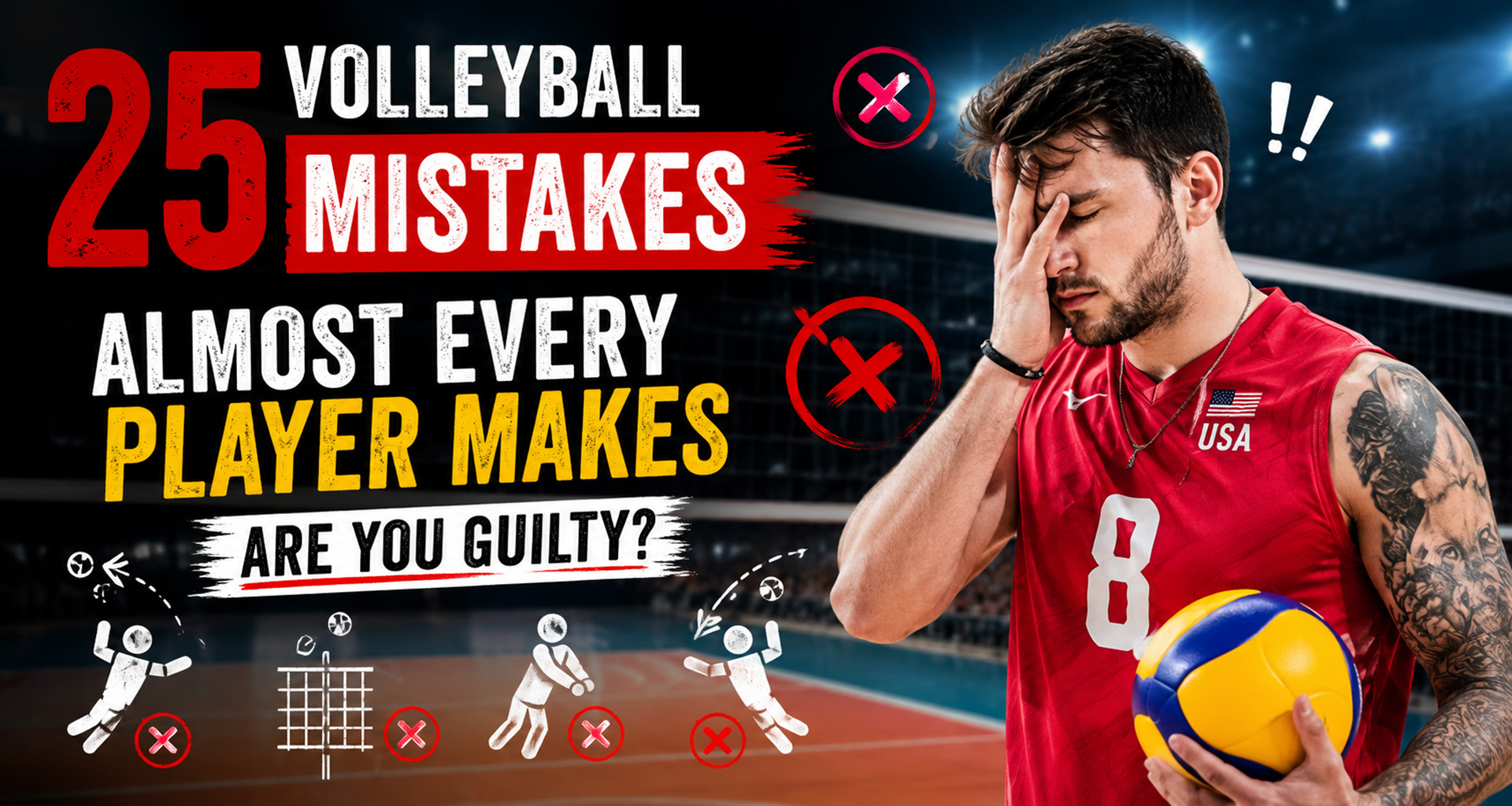
You’ll find out in my free PDF 25 of the most common volleyball mistakes I look at serving, attacking, receiving, defending, blocking and mentality, with simple tips on how to avoid them. The guide organizes them from the most complex errors to the smallest adjustments so you know what to fix first
Some of them are obvious.
Others can completely change the way you think about volleyball.
👉 Download the free guide to my free next gen heater plan below and see how many you make.
Download 25 Volleyball Mistakes
What is the biggest mistake beginner volleyball players make?
Trying to play too fast before mastering the basics. Good footwork, consistent ball control and smart decision making will get you much further than trying to hit every ball as hard as possible.
Do professional volleyball players still make mistakes?
absolutely The difference is that they recognize mistakes quickly and adjust instead of repeating them during matches.
Should I focus on fixing one mistake at a time?
yes If you try to improve ten things in one week, you probably won’t improve any of them. Pick a priority, work on it consistently, then move on to the next.
Is watching YouTube enough to improve?
Watching helps, but improvement comes when you deliberately practice a specific skill on the court.
PakarPBN
A Private Blog Network (PBN) is a collection of websites that are controlled by a single individual or organization and used primarily to build backlinks to a “money site” in order to influence its ranking in search engines such as Google. The core idea behind a PBN is based on the importance of backlinks in Google’s ranking algorithm. Since Google views backlinks as signals of authority and trust, some website owners attempt to artificially create these signals through a controlled network of sites.
In a typical PBN setup, the owner acquires expired or aged domains that already have existing authority, backlinks, and history. These domains are rebuilt with new content and hosted separately, often using different IP addresses, hosting providers, themes, and ownership details to make them appear unrelated. Within the content published on these sites, links are strategically placed that point to the main website the owner wants to rank higher. By doing this, the owner attempts to pass link equity (also known as “link juice”) from the PBN sites to the target website.
The purpose of a PBN is to give the impression that the target website is naturally earning links from multiple independent sources. If done effectively, this can temporarily improve keyword rankings, increase organic visibility, and drive more traffic from search results.