A few months ago one of my players asked me a question.
“Coach, if you could only buy one piece of training equipment, what would it be?”
He probably expected me to say a squat rack.
or precious weight.
Maybe a jump box.
Instead, I pointed to something hanging on the wall.
An elastic resistance band.
He looked disappointed.
“Seriously?”
yes
seriously
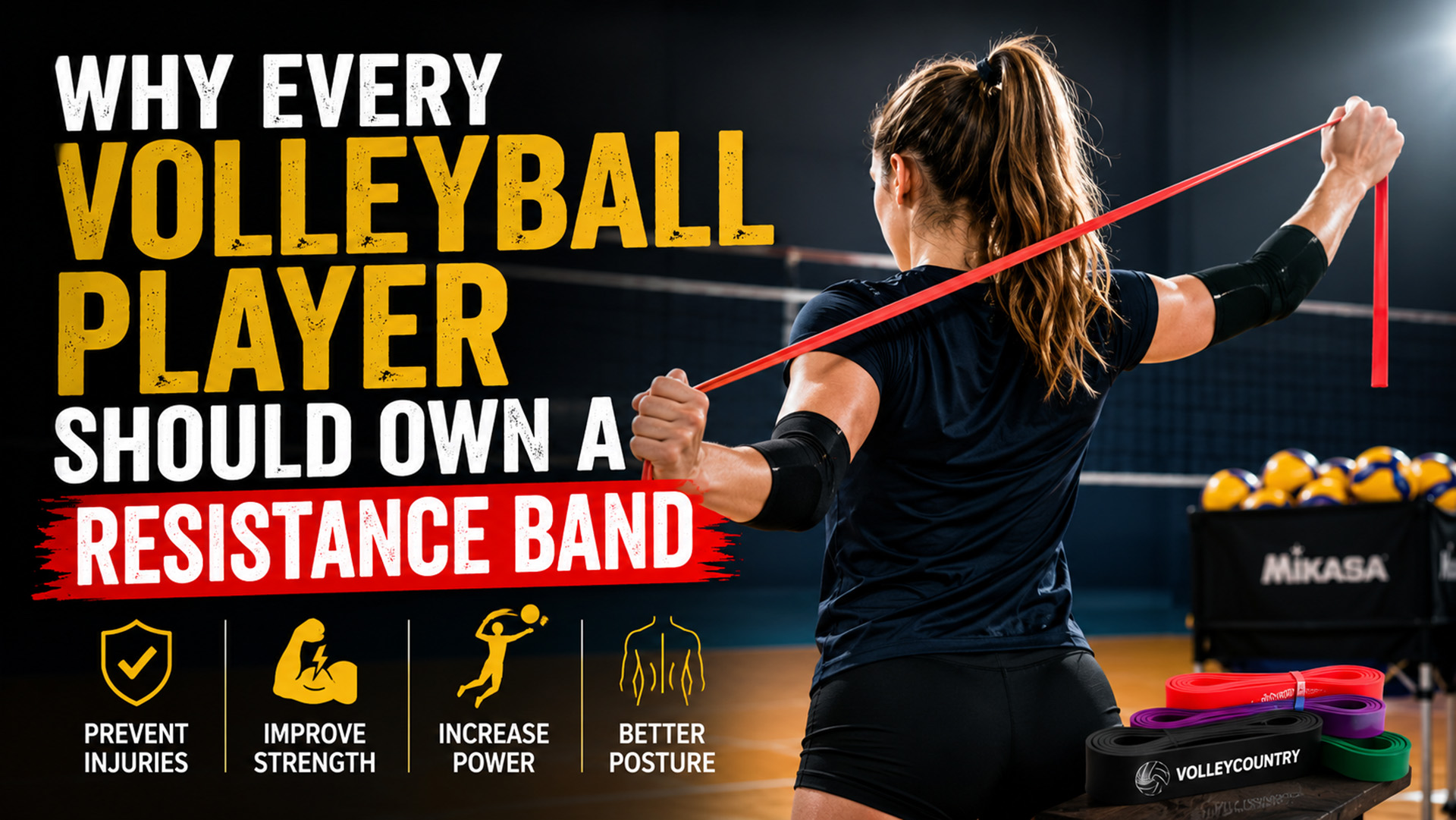
Because after more than twenty years in professional volleyball, I truly believe that a simple resistance band gives volleyball players more value than almost any other piece of equipment.
It’s not because it’s magical.
Because you will actually use it.
from my career
When I first started playing professionally overseas, I expected every club to have a secret training regime.
Instead, I keep seeing the same thing.
Before practice…
Players hold an elastic band.
Before the match…
They hold an elastic band.
After the gym…
They hold an elastic band.
I didn’t care much at first.
I thought,
“There must be something more important.”
Years later I realized that there wasn’t.
The best players never stop doing the simple things.
The biggest myth
Many young players think resistance bands are only for rehabilitation.
Your shoulder hurts.
You use a band.
The pain disappears.
You drop the band into your bag.
That’s right backwards.
The band will not appear after injury
It should be part of your routine before injury
This is how most professional players use it.
What I see every week
I coach a lot of youth players.
Almost all of them want to hit hard.
Few people want to prepare their bodies to survive a hard hit.
That’s the difference.
Everyone wants a big spike.
No one gets excited about strong rotator cuff muscles.
Until the shoulder starts to hurt.
Then suddenly everyone wants elastic bands.
Resistance bands do more than protect your shoulders
This is another thing that many players don’t understand.
A resistance band isn’t just about injury prevention.
You can improve it using:
- Shoulder stability
- hand motion
- pose
- Key activation
- Hip strength
- Activating the adhesive
- Ankle stability
That’s why I always pack one when I travel.
It weighs almost nothing.
Yet you can train almost your entire body with it.
If you will be my player…
I’m not asking you to spend an extra hour at the gym.
I’ll ask for five minutes.
Five minutes before practice.
Five minutes after exercise.
completed
Players who are healthy most of the time usually don’t do extraordinary workouts.
They are the ones who repeat simple habits over the years.
One thing changed my mind
When I was younger, I thought training only counted if I was tired.
Today I think completely differently.
There are some valuable exercises you’ll ever do that won’t leave you sweating.
They only prepare your body to do better tomorrow.
Elastic band work falls into that category.
You probably won’t post it on Instagram.
But your shoulders will thank you in five years.
My challenge for you
For the next two weeks, don’t change your volleyball training at all.
Just add five minutes of resistance band exercise before each workout.
Nothing else.
Then ask yourself a question.
“Does my shoulder feel different after training?”
I think you will be surprised.
Do I want recommended routines for my players?
Over the years I have collected resistance band exercises that I often use with young hitters and veteran players.
Not fifty exercises.
Only I believe is actually a difference.
They are simple.
They only take a few minutes.
And they’re the same routine I wish someone had given me much earlier in my career.
Check out my elastic band course (it’s free) and give it a try.
PakarPBN
A Private Blog Network (PBN) is a collection of websites that are controlled by a single individual or organization and used primarily to build backlinks to a “money site” in order to influence its ranking in search engines such as Google. The core idea behind a PBN is based on the importance of backlinks in Google’s ranking algorithm. Since Google views backlinks as signals of authority and trust, some website owners attempt to artificially create these signals through a controlled network of sites.
In a typical PBN setup, the owner acquires expired or aged domains that already have existing authority, backlinks, and history. These domains are rebuilt with new content and hosted separately, often using different IP addresses, hosting providers, themes, and ownership details to make them appear unrelated. Within the content published on these sites, links are strategically placed that point to the main website the owner wants to rank higher. By doing this, the owner attempts to pass link equity (also known as “link juice”) from the PBN sites to the target website.
The purpose of a PBN is to give the impression that the target website is naturally earning links from multiple independent sources. If done effectively, this can temporarily improve keyword rankings, increase organic visibility, and drive more traffic from search results.